Why Does Kash Patel Still Have a Job?
By Ben Cable for Citizen Ben (Crossposted on Substack)
For years, Donald Trump has demanded loyalty above competence. That formula has produced a long list of cabinet officials, advisers, lawyers, and agency heads who remained in power until the scandals became too large to ignore.
The question now being whispered inside Washington is simple:
Why does Kash Patel still have a job?
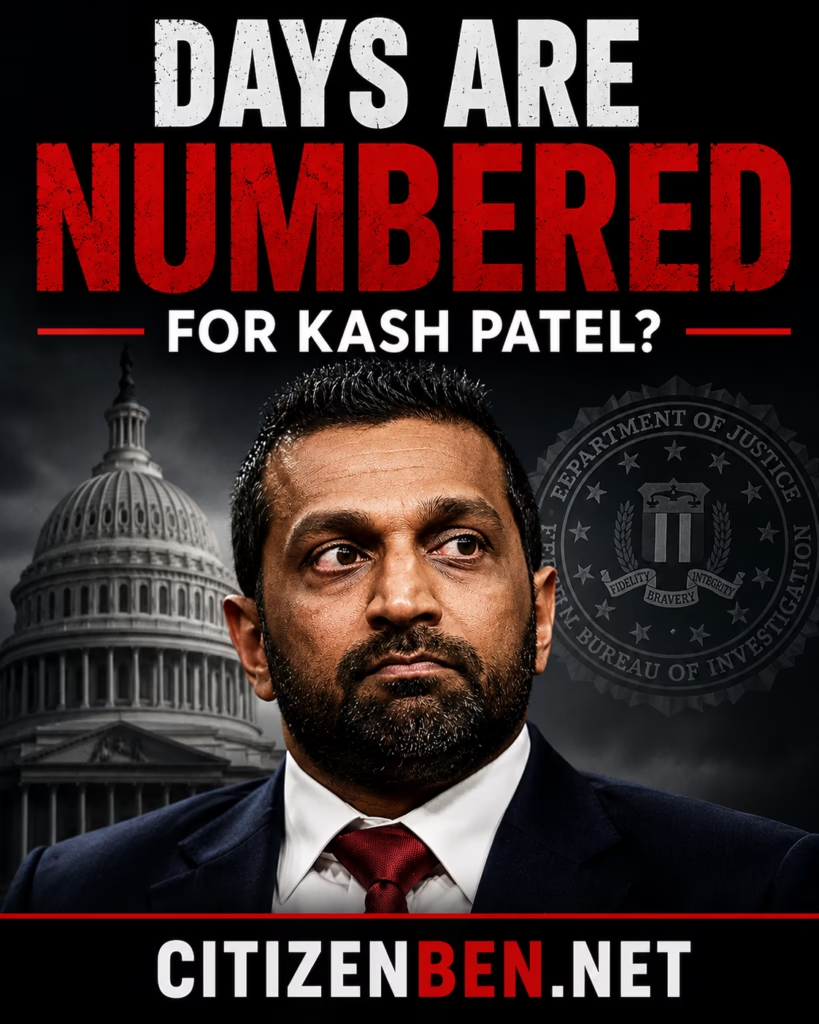
The FBI Director has become one of the most controversial figures in the Trump administration, facing allegations involving misuse of government resources, questionable travel, retaliatory management practices, and a growing number of investigations into his conduct.
Whether Patel survives may depend less on what he has done and more on whether his political usefulness to Donald Trump outweighs the mounting controversy surrounding him.
The Brown University Debacle
One of the most damaging episodes came after the deadly Brown University shooting in December 2025.
Before investigators had confirmed the identity of the suspect, Patel publicly celebrated the detention of a “person of interest” and suggested law enforcement had made significant progress.
The problem?
The man was innocent.
CBS News later reported that the individual Patel highlighted had no connection to the shooting and was released shortly afterward. The premature announcement created confusion during a rapidly developing investigation and raised questions about whether Patel was more interested in publicity than police work. According to reporting by The Guardian, critics accused Patel of rushing to social media before investigators had completed their work.
For career FBI personnel, it was another example of a director many reportedly view as prioritizing politics and headlines over investigative discipline.
Another Investigation, Another Victory Lap
If Kash Patel’s critics have one recurring complaint, it is this:
He cannot seem to wait.
That concern resurfaced again this week after Patel publicly announced that the FBI had disrupted a major plot targeting the UFC Freedom 250 event held on the White House grounds.
According to court documents unsealed Tuesday, federal authorities allege that a network of suspects planned to use explosive-laden drones to create panic before launching sniper attacks against fleeing attendees. Five suspects have been arrested, but investigators believe the conspiracy may have involved more than 20 individuals operating across multiple states.
The FBI deserves credit for stopping the alleged attack.
The question is whether Patel once again put publicity ahead of investigative discipline.
NBC News national security correspondent Ken Dilanian reported that some Secret Service officials were furious that Patel publicly discussed the case while investigators were still pursuing leads. According to court filings, authorities believe the network extended far beyond the individuals initially arrested, raising concerns that public disclosures could alert additional suspects or compromise investigative strategies.
For critics inside federal law enforcement, the episode felt familiar.
Just months earlier, Patel faced bipartisan criticism after publicly claiming a suspect had been taken into custody in the Charlie Kirk assassination investigation. Within roughly 90 minutes, the FBI was forced to acknowledge that the individual Patel referenced had no connection to the shooting and had been released. Congressional hearings later focused on Patel’s handling of the case and on whether his social media announcements had undermined confidence in the investigation.
Now, critics argue, Patel appears to be repeating the same pattern: rushing to claim victory before investigators have finished their work.
Federal investigations often depend on secrecy, surveillance, cooperating witnesses, confidential informants, and the ability to monitor communications without alerting remaining suspects.
When the FBI Director rushes to the spotlight before those operations conclude, agents are left asking a simple question:
Is the priority building the strongest case possible—or generating the best headline possible?
For a Bureau that once prided itself on speaking only through indictments and court filings, the distinction matters.
The FBI Jet Problem
Then came the airplane stories.
Congressional Democrats and multiple news organizations have raised questions about Patel’s use of FBI aircraft for trips that appeared to blur the line between official business and personal travel.
Among the allegations:
- Flights connected to social events and entertainment outings.
- Travel involving his girlfriend, country singer Alexis Wilkins.
- Questions regarding whether taxpayers were subsidizing travel with limited or questionable law-enforcement purposes.
Reports have described flights to concerts, sporting events, Hawaii excursions, and other trips that critics say appear difficult to justify as FBI business. Patel has denied wrongdoing and has argued that his travel complied with applicable rules and security requirements.
But even if every flight technically complied with regulations, many former FBI officials argue that the optics are disastrous.
The Bureau’s credibility depends on public trust.
Trust erodes quickly when the Director appears to be living a lifestyle more associated with celebrity culture than federal law enforcement.
Drinking Allegations
If the travel controversies were not enough, Patel now finds himself confronting perhaps the most personally damaging allegations of his tenure.
In April, The Atlantic published an explosive investigation alleging that Patel’s behavior had alarmed current and former government officials. According to the report, officials described episodes of excessive drinking, unexplained absences, and concerns that Patel was at times unavailable during periods when the nation’s top law-enforcement official should have been reachable. The report cited more than two dozen current and former officials. Reuters later confirmed that Patel responded by filing a $250 million defamation lawsuit against the magazine and reporter Sarah Fitzpatrick. Patel has categorically denied the allegations and accused the publication of publishing false information.
What transformed the story from Washington gossip into a national controversy were the details.
According to reporting cited by The Guardian, multiple officials alleged that members of Patel’s security detail had difficulty waking him on more than one occasion. One reported incident allegedly became so serious that personnel discussed obtaining “breaching equipment” to gain access after being unable to reach him behind locked doors. Officials interviewed by The Atlantic reportedly expressed concern about what might happen if a major terrorist attack or national security emergency occurred while Patel was unreachable.
The allegations did not stop there.
The Guardian reported that current and former officials claimed Patel frequently spent weekends in Las Vegas and was known for late-night socializing that occasionally disrupted meetings and schedules. Critics argued that the pattern painted a picture of an FBI Director more focused on celebrity appearances, sporting events, and nightlife than on the Bureau’s day-to-day management.
The controversy escalated further when House Judiciary Committee Democrats, led by Representative Jamie Raskin, launched an inquiry into the allegations and formally requested that Patel undergo alcohol-abuse screening. Congressional Democrats argued that if the reports were accurate, they raised serious national security concerns regarding the leadership of the FBI.
Patel has vigorously denied every allegation. During congressional testimony, he stated, “I’ve never been intoxicated on the job,” and accused critics and media outlets of spreading politically motivated falsehoods. The White House has also defended Patel and continues to express confidence in his leadership.
But the larger issue may not be whether every allegation is true.
The issue is that so many current and former officials appear willing to talk about them.
When agents, supervisors, and government personnel begin openly questioning whether the FBI Director is available, focused, and capable of managing crises, the controversy becomes bigger than one magazine article.
It becomes a leadership problem.
Security for the Girlfriend
Perhaps even more controversial were reports that FBI resources were used to provide security protection for Patel’s girlfriend.
News reports and congressional critics questioned whether taxpayer-funded personnel were being diverted for personal purposes. Subsequent reporting noted that Wilkins received FBI protection due to threats associated with Patel’s position and public profile.
Wilkins has denied allegations that she improperly used FBI resources and has pursued legal action against media outlets over some claims.
The broader issue remains unresolved:
How much of the FBI’s limited manpower should be dedicated to protecting people who are not government officials?
And who made those decisions?
The “Payback Squad” Allegations
Now comes what may become Patel’s biggest problem.
House Judiciary Committee Ranking Member Jamie Raskin has launched an investigation into allegations that Patel directed more than $1 million in bonus payments to a small group of favored personnel.
According to Raskin’s letter, some individuals reportedly received repeated payments approaching $8,000 per pay period, with some accumulating nearly $40,000 in bonuses. The investigation seeks to determine whether the payments were lawful, exceeded normal compensation limits, and were used to reward political loyalty.
The allegations are explosive.
Critics have described the arrangement as a potential “slush fund.” Raskin’s office has suggested the payments may have benefited members of Patel’s inner circle, including personnel who allegedly carried out controversial assignments. Patel has not been found guilty of wrongdoing, and the allegations remain under investigation.
Still, even the appearance of rewarding loyalists with taxpayer funds runs directly counter to the FBI’s traditional image as a nonpartisan institution.
Revenge Politics and Loyalty Tests
Patel arrived at the FBI after years of positioning himself as one of Trump’s most aggressive defenders.
Long before becoming Director, Patel openly attacked officials involved in investigations of Trump and frequently framed federal law enforcement as part of a political conspiracy against the former president.
That history alarmed critics who feared the FBI would be transformed from an independent investigative agency into a vehicle for political score-settling.
Since Patel’s appointment, thousands of agents and personnel have reportedly departed or been pushed out of the Bureau. Former agents have described an atmosphere of fear, retaliation, and political pressure. Some have formed support organizations specifically to help those leaving the agency.
Whether every accusation is fair remains debated.
But the sheer volume of complaints has become difficult to ignore.
The Real Question
The question is no longer whether Kash Patel has generated controversy.
That question has been answered.
The real question is why none of it appears to matter.
Imagine for a moment that an FBI Director appointed by Barack Obama or Joe Biden had been accused of:
- Using government aircraft for questionable travel.
- Providing taxpayer-funded security linked to a romantic partner.
- Prematurely announcing a suspect who turned out to be uninvolved.
- Directing large bonus payments to favored insiders.
- Presiding over an exodus of experienced personnel.
Congressional hearings would likely dominate cable news for weeks.
Instead, Patel remains firmly in place.
That may be because his most important qualification was never law enforcement expertise.
It was loyalty.
And in Trump-world, loyalty has often been the one offense that cannot be forgiven.
Everything else is negotiable.
What Happens Next?
The congressional investigations into Patel’s conduct are only beginning.
If investigators obtain documentation supporting allegations regarding bonus payments, travel expenditures, or misuse of resources, pressure could intensify rapidly.
If the allegations prove exaggerated or unsupported, Patel may survive yet another controversy.
But history suggests that Washington scandals rarely disappear.
They accumulate.
And Kash Patel’s file is becoming very thick indeed.
The question is not whether there will be another controversy.
The question is whether the next one is the one that finally matters.
Citizen Ben’s Crystal Ball: Kash is out of his job as soon as Trump finds another lackey to head the FBI, and it will be very soon.
What do you think?
Should Congress open a full bipartisan investigation into Kash Patel’s management of the FBI?
Vote in the poll below and share your thoughts in the comments.
About the Author