Everything Trump Touches Turns Into Algae
Ben Cable Reposted from Substack Jun 16, 2026
Donald Trump promised America a lot of things.
A beautiful wall.
Beautiful healthcare.
Beautiful trade deals.
Beautiful peace.
Beautiful infrastructure.
Beautiful respect for America.
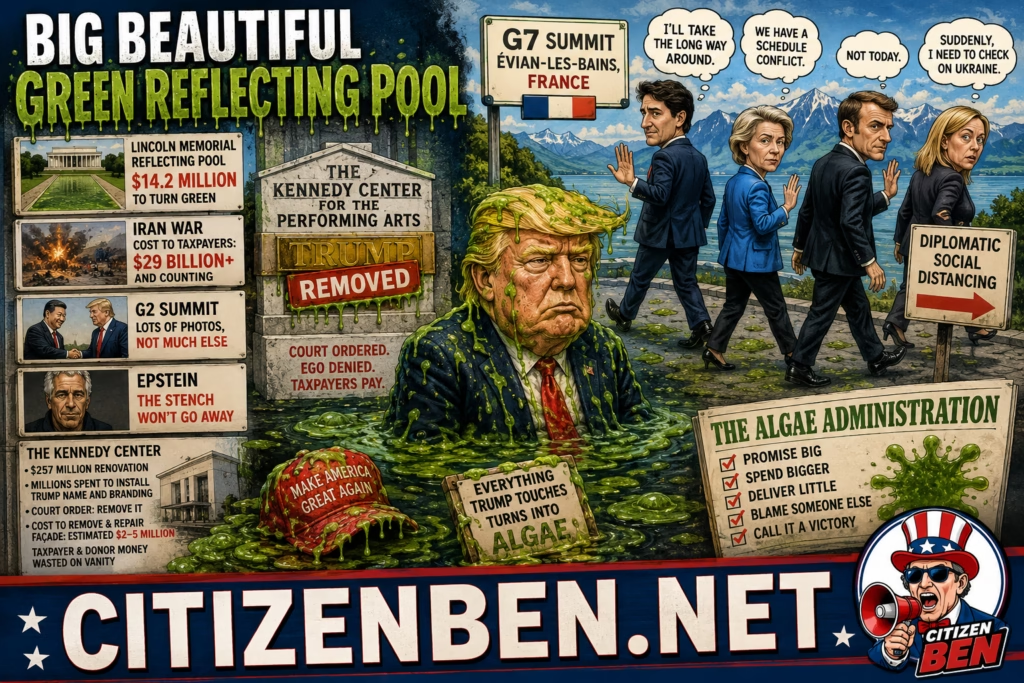
Now he’s given us something undeniably beautiful in its own peculiar way: a $14.2 million reflecting pool that turned bright green with algae almost immediately after completion.
You couldn’t write satire this good.
Actually, you can. You’re reading it.
The Lincoln Memorial Reflecting Pool was supposed to be one of Trump’s signature projects ahead of America’s 250th birthday celebration. Trump reportedly wanted the water to be “American Flag Blue.” The project was initially pitched at roughly $1.8 million. It eventually ballooned to more than $14 million. Then, within days, the algae came back.
The administration insists this is merely a temporary startup problem. Perhaps.
But as political metaphors go, it is almost too perfect.
A project sold as a quick, inexpensive fix winds up costing eight times more than advertised and immediately develops the exact problem it was supposed to solve.
If that sounds familiar, welcome to Trump 2.0.
The Green Pool Presidency
The reflecting pool isn’t really about algae.
It’s about a governing style.
Trump has always preferred spectacle over maintenance. Announcements over execution. Ribbon cuttings over long-term planning.
The pool’s makeover included a specialized coating, repairs, and an expensive nanobubbler system intended to suppress algae growth. Yet the public debut was quickly overshadowed by photographs of green water spreading across the very monument Trump promised to restore.
Washington insiders spent years talking about “shovel-ready projects.”
Trump may have invented a new category:
Photo-ready projects.
Unfortunately, reality tends to arrive shortly after the cameras leave.
The Iran War: The Cost of “Winning”
If the algae problem is a metaphor, the Iran war is a ledger.
The administration entered the conflict promising strength, deterrence, and a quick resolution. Instead, Americans have watched months of escalating costs, economic disruption, and geopolitical uncertainty.
How much has it cost?
Depends on whom you ask.
The Pentagon reported war costs exceeding $25 billion by late April and approximately $29 billion by May. Reuters reported the figure while noting growing political concerns over inflation and household costs.
Defense analysts at CSIS estimated that just the first twelve days of combat operations may have cost approximately $16.5 billion. Today, it is estimated at $50 billion U.S. Dollars.
Other analysts have projected broader economic costs reaching into the hundreds of billions of dollars if energy shocks, military deployments, and long-term obligations are included.
That’s a lot of money to spend so Americans can once again hear politicians explain why the conflict is “turning a corner.”
We’ve heard that phrase before.
In Vietnam.
In Iraq.
In Afghanistan.
Corners are apparently very expensive.
The French G7: Diplomatic Social Distancing
At the G7 summit in Évian-les-Bains, France, world leaders appeared to approach Trump the way tourists approach a suspiciously green reflecting pool: politely, from a distance, and with no sudden movements.
Reuters reported before the summit that France had adjusted the schedule and agenda to accommodate Trump and avoid open clashes, especially over Iran, Ukraine, and global trade.
That did not exactly produce a lovefest.
A hot mic reportedly caught French President Emmanuel Macron telling Volodymyr Zelenskyy that he had a “difficult” discussion with Trump on Iran, tariffs, Ukraine, and even Greenland.
Meanwhile, British Prime Minister Keir Starmer had to deny being snubbed after not getting a formal bilateral meeting with Trump.
This is what passes for diplomacy in the algae era: allies smiling for the cameras while quietly checking whether the exit is closer than the buffet.
The #Epstein Problem Won’t Go Away
And then there is Jeffrey Epstein.
The story that refuses to stay buried.
Recent polling shows that only a small percentage of Americans believe the administration has delivered meaningful accountability in the Epstein matter. Most respondents believe powerful people continue to avoid consequences, and a large majority suspect important information remains hidden from the public.
Meanwhile, reports of internal administrative turmoil over the handling of the files continue to generate headlines. Congressional scrutiny has intensified, and questions remain unanswered.
The political problem for Trump isn’t necessarily what is in the files.
The political problem is that every promise of transparency seems to create another round of questions.
And questions have a nasty habit of reproducing faster than algae.
The Kennedy Center: Ask Not What Your Country Can Name After Trump
Then there was the Kennedy Center.
Trump’s board tried to slap his name onto the John F. Kennedy Center for the Performing Arts — because apparently “Kennedy Center” was too subtle and not nearly gold-plated enough. A federal judge ruled the move illegal, saying Congress, not Trump’s handpicked board, has authority over the name. The court also blocked a planned two-year closure tied to a proposed $257 million renovation. Workers later removed Trump’s name from the façade after appeals failed.
So taxpayers and donors got the full Trump special: install the ego, litigate the ego, remove the ego, repair the marble where the ego used to be, then hide the evidence under a tarp. The center says the tarp remains while the façade is repaired, but as metaphors go, it deserves its own Kennedy Center Honors medallion.
And because the name could not stay on the building, CBS reported the Kennedy Center is now creating a Trump-named endowment tied to existing private endowments and its $257 million in federal funding.
Even the arts got turned into a branding exercise.
Not Camelot.
Mar-a-Lago with acoustics.
Everything Trump Touches Turns Into Algae
That may sound harsh.
But consider the pattern.
A $14 million pool turns green.
A war marketed as strength produces billions in costs.
A summit marketed as historic delivers incremental results.
Promises of transparency generate new controversy.
At some point the issue isn’t the individual project.
It’s the operating system.
Trump’s political brand has always been based on the idea that he alone can fix things.
But fixing things requires something more than branding.
It requires competence.
Maintenance.
Patience.
Follow-through.
The boring stuff.
The stuff that never makes it onto hats, banners, or campaign slogans.
The reflecting pool was supposed to symbolize national renewal.
Instead, it became a reminder that reality eventually shows up with a bucket of algae.
And reality, unlike a press conference, can’t be rescheduled.
What You Can Do
- Follow multiple news sources, not just partisan ones.
- Read original documents whenever possible.
- Ask questions when costs suddenly multiply.
- Demand transparency regardless of party.
- Remember that government isn’t judged by announcements. It’s judged by results.
Because in the end, water tells the truth.
And right now, America’s most famous reflecting pool is reflecting quite a lot.
Everything Trump touches does not become gold. Some of it becomes litigation. Most becomes debt. Some becomes a tarp. And some, quite literally, become algae.
About the Author