Ben Cable, April 20, 2026 (Crossposted on Substack)
On Easter morning, Donald Trump didn’t just rattle sabers—he lit the fuse.
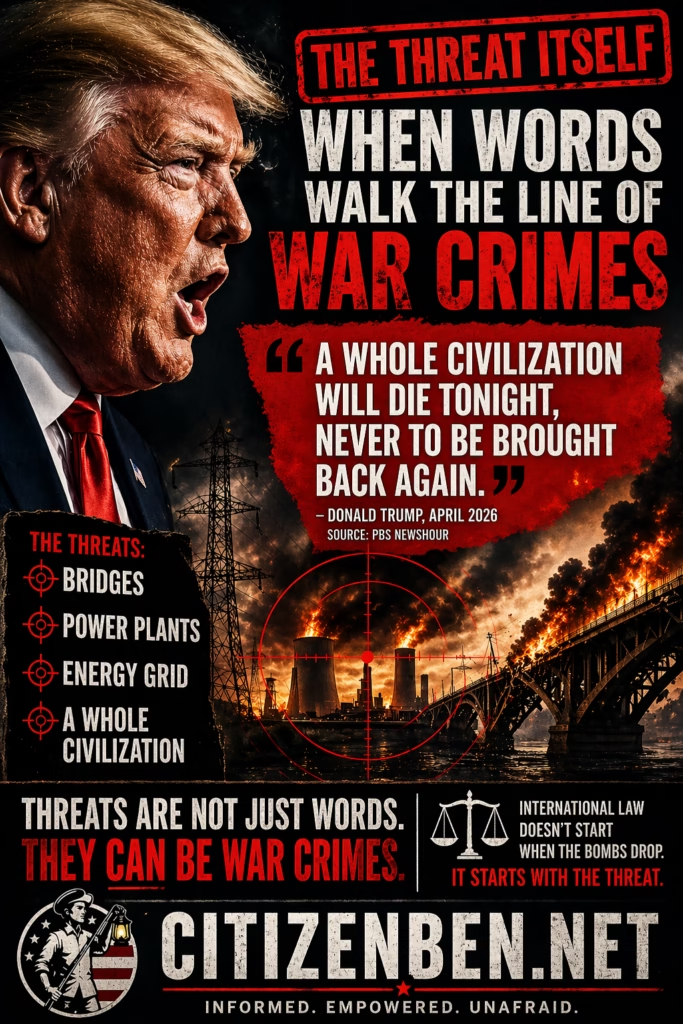
He threatened to wipe out Iran’s civilian infrastructure—bridges, power plants, and more—if Tehran didn’t comply with U.S. demands. He warned of what he called “Power Plant Day” and “Bridge Day,” language that reads less like diplomacy and more like a demolition schedule.
And then, from our United States President, the man who holds our nuclear bomb codes, came the line that should stop everyone cold:
“A whole civilization will die tonight, never to be brought back again.”
— Donald Trump, April 2026 (PBS NewsHour)
That’s not coded language.
That’s not strategic ambiguity.
That’s a direct threat of mass civilian destruction.
THE LEGAL LINE: WHEN IS A THREAT A WAR CRIME?
Let’s be clear—because this matters.
Under the Geneva Conventions and the statutes of the International Criminal Court:
- War crimes include targeting civilians or civilian infrastructure
- This includes objects indispensable to survival—electricity, water systems, transport networks
Now here’s the critical twist:
A threat is not automatically a war crime.
But a threat becomes illegal if the act being threatened would be illegal.
The International Court of Justice made this explicit:
If the use of force would violate humanitarian law, threatening that use can also be unlawful.
REAL-WORLD EXAMPLE: IRAN, 2026
Let’s walk it through together—step by step.
1. The Threat
Public, specific, and repeated:
- Bridges
- Power plants
- National infrastructure
Not military bases. Not battlefield targets.
Civilian lifelines.
2. The Target
Bridges and power grids are:
- Civilian-critical
- Essential for hospitals, water, food supply
Destroy them, and you don’t just hit a government—
you hit millions of civilians at once.
3. The Legal Test
International law asks:
- Is the target military?
- Is civilian harm proportional?
- Is the intent to terrorize?
A statement about ending “a whole civilization” doesn’t pass that test easily.
4. The Consequence
Even before a strike:
- Panic spreads
- Civilians mobilize
- Infrastructure becomes leverage
That’s not just strategy—
That is psychological pressure on a population, something the Geneva Conventions explicitly restrict.
THE BOTTOM LINE (AND THE DANGER)
Here’s the truth most politicians won’t say plainly:
You don’t have to commit a war crime to start crossing into one.
A threat like this sits on a razor’s edge:
- If it’s deterrence → possibly legal
- If it signals unlawful intent → possibly not
And when the language escalates to:
- wiping out infrastructure
- collapsing essential services
- ending a civilization
…it stops sounding like policy and starts sounding like collective punishment.
CITIZEN BEN
“When you threaten to turn the lights off on an entire nation, you’re not just talking war—you’re flirting with war crimes.”
WHAT YOU CAN DO NOW
- Call your representatives: demand clarity on U.S. compliance with international law
- Support watchdog organizations tracking potential war crimes
- Stay informed—because rhetoric like this doesn’t stay rhetoric for long
FINAL WORD
History doesn’t just judge what leaders do.
It judges what they promise to do—
and who they’re willing to sacrifice to prove a point.
And right now, the line between threat and crime isn’t theoretical.
It’s one decision away.
About the Author