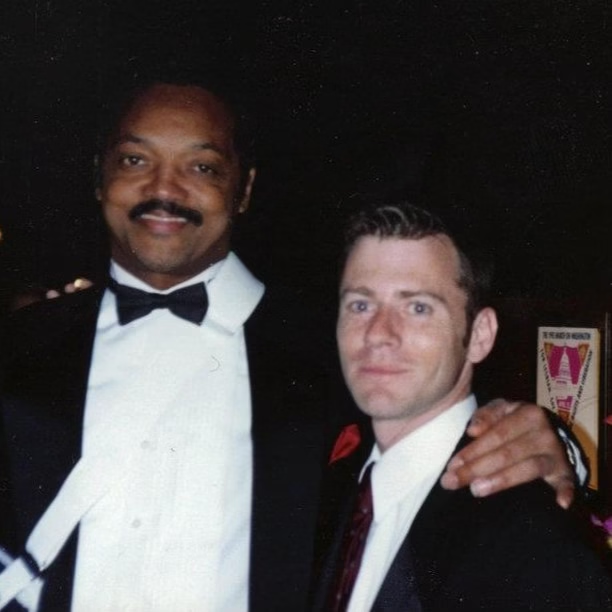
Some heroes wore a cape. My hero wore a suit and tie.
Ben Cable
A charismatic preacher and tireless organizer, Reverend Jesse Jackson became the most visible voice of Black American aspiration in the years after the assassination of the Rev. Martin Luther King Jr., carrying forward an unfinished moral project at a moment when the nation desperately needed one.
His family did not disclose a cause of death. In recent years, Jackson’s health declined following a Parkinson’s diagnosis in 2015, later complicated by progressive supranuclear palsy, a rare neurological disorder that gradually limited his movement. Even as his body slowed, his legacy—restless, insistent, unavoidable—remained very much in motion.
At the height of his influence, Jesse Jackson was everywhere. He was a constant presence at protests and marches, in church basements and union halls, before television cameras and skeptical audiences alike. He understood the power of visibility, and he wielded it deliberately. Widely regarded as the nation’s preeminent civil rights leader of his era, Jackson showed up—again and again—to insist that justice was not seasonal, optional, or negotiable.
In 1968, Rev. Jackson was on the balcony when Martin Luther King was assassinated. When cities erupted in grief and rage—after King’s murder, and decades later following the police killing of Michael Brown in Ferguson—Jackson urged restraint and nonviolence. Not because he misunderstood the anger, but because he believed discipline was the difference between chaos and change. Justice, in his view, demanded courage and control in equal measure.
He was also a political pioneer. Long before America could imagine a Black president, Jesse Jackson ran for the highest office in the land. His presidential campaigns in the 1980s were not symbolic gestures; they were structural interventions. He forced the Democratic Party—and the country—to confront who power was for, and who it had long excluded. The Rainbow Coalition he championed expanded the very idea of political belonging.
It was within that long arc of courage, visibility, and conviction that my own life briefly intersected with his.
In 1993, Marcial Cable-McCarthy and I were already fighting a battle most people warned us would ruin our lives. We were among the earliest couples to challenge the law for marriage equality, back when supporting gay and lesbian marriage was not merely unpopular—it was considered political suicide. Friends urged caution. Allies whispered doubts. The costs were emotional, financial, and relentless.
That same year, amid that uncertainty, I found myself standing at the National Press Club during the March on Washington, sharing the podium with Jesse Jackson. The room was filled with reporters’ cameras, microphones, and the weight of history. I carried with me not just a question, but a need—for clarity, for courage, for reassurance that we were not alone.
After I made brief remarks to the press, I asked Rev. Jackson, who was standing beside me, directly whether he supported gay marriage.
There was no pause for calculation. No hedging for headlines. No searching for safe language.
He simply answered: “And why not?”
It was only three words, but they landed like a benediction.
In a moment when the road ahead felt impossibly steep, when the fight for dignity demanded more than we knew how to give, his answer offered something rare: moral certainty without condition. That affirmation stayed with me through legal setbacks and sleepless nights.
Jesse Jackson did not just lead movements. He understood that history is also made in moments—when someone with a microphone chooses principle over polling, humanity over hesitation. Sometimes leadership looks like thunder. Sometimes it looks like a simple question answered without fear.
Reverend Jesse Jackson turned to me and asked, “And why not?”
That is how I will remember him.
About the Author